
Septic to Sewer Conversion in Kamloops: What Happens to Your Old Septic System?
Key Takeaways
- A septic to sewer conversion in Kamloops doesn’t mean your old tank just disappears — it must be properly decommissioned under BC regulations.
- Your septic tank needs to be pumped out completely before it can be abandoned or removed.
- In BC, decommissioning rules are governed by the Sewerage System Regulation — ignoring them can cost you at resale.
- Most homeowners are surprised to learn they’re responsible for the lateral connection from their house to the City’s main sewer line.
- Getting the tank pumped out first is step one — and it’s one of the most straightforward parts of the whole process.
Introduction
If the City of Kamloops has extended municipal sewer to your street and you’re finally making the switch, congratulations — you’re about to say goodbye to maintenance schedules, field lines, and the occasional mystery smell in the backyard. But here’s what most homeowners don’t realize: a septic to sewer conversion in Kamloops doesn’t end the moment you connect to the City main. Your old septic system is still sitting in your yard, full of liquid and sludge, and it needs to be dealt with properly before anyone signs off on anything.
We’ve helped a lot of Kamloops-area homeowners through this exact process. The plumbing side gets sorted. The new lateral gets trenched in. And then someone asks, “So… what do we do with the tank?” That’s where we come in. This post walks you through exactly what happens to your septic system when you connect to municipal sewer — and what you absolutely cannot skip.
Step One: Your Septic Tank Has to Be Pumped Out. No Exceptions.
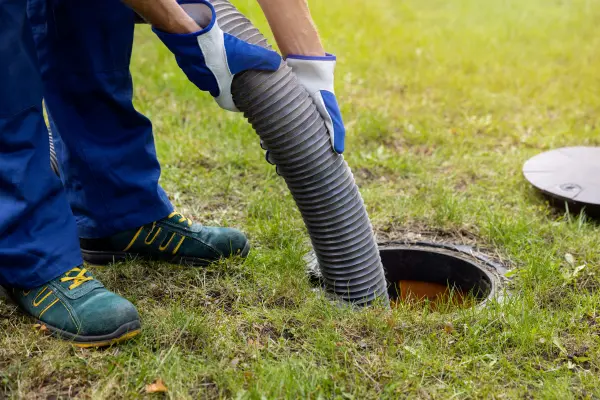
Before anything else happens to your old septic tank — before it gets crushed, filled, or abandoned in place — it needs to be completely pumped out. This isn’t optional, and it’s not just a good idea. It’s the first required step under BC’s Sewerage System Regulation (BC Reg. 129/2004), which governs how septic systems are decommissioned in this province.
We had a homeowner in the Brocklehurst area reach out last spring. They’d already had the new sewer lateral installed and were ready to call the job done. Their contractor had told them the tank could just be “left alone.” It can’t. The tank still had several hundred gallons of septage in it. Left untreated, that material continues to break down, can leach into surrounding soil, and becomes a liability — especially if you ever go to sell the property. A BC home inspector will flag an undecommissioned septic tank every single time.
Pumping the tank is fast. For a standard 1,000–1,500 gallon concrete tank — which is common on older Kamloops properties — we’re usually in and out in under an hour. That’s the easy part. What comes next requires a bit more planning.
Our septic tank pumping and cleaning services cover exactly this — we handle the pump-out, document what we removed, and can walk you through what your decommissioning options are from there.

Abandon in Place or Full Removal? What BC Actually Requires.
Once the tank is pumped out, you’ve got two options: remove it entirely, or abandon it in place. Most Kamloops homeowners go with abandon-in-place because it’s significantly less expensive and less disruptive to your yard. But there are rules around how it’s done.
Under BC’s Sewerage System Regulation, a tank being abandoned in place must be:
- Completely pumped out (see above)
- Rendered structurally safe so it can’t collapse and create a sinkhole
- Filled with sand, gravel, or concrete so the void is eliminated
- The inlet and outlet pipes must be capped or sealed
Full removal makes sense in some situations — particularly if you’re planning a major renovation, building a new structure over the tank’s location, or if the tank is fibreglass and already showing signs of deterioration. Concrete tanks are generally stable enough to abandon in place. Fibreglass tanks can degrade and collapse over time, so we tend to recommend removal when possible.
Here’s our honest take: most Kamloops properties we service have older concrete tanks that were installed in the 1970s through the 1990s. They’re heavy, they’re deep, and excavating them is a significant job. If the tank is structurally sound, abandoning in place — done correctly — is a perfectly acceptable outcome. The City of Kamloops doesn’t require full removal in most residential cases, but they do require proof that the decommissioning was handled properly.
If you’re curious about the different tank types you might be dealing with, our post on What Are the Three Types of Septic Tanks? gives you a clear breakdown of concrete, fibreglass, and plastic tanks — and why it matters for decommissioning.
What About the Field Lines?
The septic tank is only part of your system. Most properties also have a distribution box and a drainfield — sometimes called a leachfield or absorption field. These don’t get pumped out the same way a tank does, but they still need to be addressed.
In most Kamloops residential conversions, the drainfield is simply decommissioned and left in place. The distribution box should be disconnected and capped. The perforated pipes in the field itself can remain in the ground — they’re inert at that point. The soil around them has been doing its job for years and will continue to biologically neutralize any remaining organic material over time.
What you don’t want is an active connection between your old field lines and anything that’s still receiving flow. That’s where we’ve seen problems. One homeowner in Westsyde discovered their plumber had connected to the municipal sewer but hadn’t properly capped the old distribution box. Rainwater was running into the old system, saturating the field, and creating a soggy mess in the corner of the yard. Not a disaster, but a completely avoidable headache.
The field lines don’t need to be excavated. They don’t need to be filled. They just need to be disconnected from any active flow and left to rest. Simple — as long as the disconnection is done properly.
The Part Kamloops Homeowners Are Most Surprised By: The Lateral Is Your Responsibility
Here’s the piece of the puzzle that catches people off guard almost every time. When you connect to the City of Kamloops municipal sewer system, the City owns and maintains the main sewer line running under your street. But the lateral — the pipe that runs from your house to the City’s main — is your responsibility. You pay for it. You maintain it. If it breaks, it’s on you.
Depending on how far your house sits from the street, that lateral can be 20 feet or 80 feet of trench work. In older Kamloops neighbourhoods where properties are set back further, costs can climb quickly. We’ve heard from homeowners who budgeted for a straightforward connection and ended up spending $8,000–$15,000+ on the lateral alone once they factored in trench depth, road crossings, and permit fees.
The City of Kamloops does offer a sewer connection incentive program for properties being converted from septic — it’s worth checking with the City directly for current details, as program availability and rebate amounts change. What we can tell you is this: don’t assume the connection is cheaper just because the main sewer line is already at the curb.
For a realistic look at what septic system work costs in this area, our post on What Is the Price of a Septic System in Kamloops? covers the numbers honestly — including what factors drive costs up or down in the Thompson-Okanagan region.
Do You Need a Permit to Decommission a Septic System in Kamloops?
Short answer: yes, in most cases.
In BC, septic system decommissioning must be completed by a Registered Onsite Wastewater Practitioner (ROWP) or under one’s supervision, and the work is typically subject to a permit through your local health authority — which in Kamloops falls under Interior Health. The decommissioning report gets filed with Interior Health and becomes part of the property record.
This matters more than most people realize. When you go to sell your home, a buyer’s real estate lawyer or home inspector will look for that record. If the tank was abandoned without a proper permit and decommissioning report, you could be asked to redo the work — or at minimum, provide documentation — before the sale closes. We’ve seen this delay closings. We’ve seen it fall through deals entirely.
The Interior Health Authority’s Environmental Health – Sewage Disposal page outlines the requirements for onsite sewage systems in the region, including decommissioning. It’s dry reading, but worth knowing what the rules are before you start digging.
Our strong recommendation: book the pump-out first, then confirm your decommissioning plan with a ROWP before any physical work begins. The sequence matters, and skipping steps creates paperwork headaches down the road.
Conclusion
Connecting to the City of Kamloops sewer system is genuinely good news for your property — less maintenance, no more pump-out schedules, no field line worries. But the old septic system doesn’t just disappear the moment you flip the switch. It needs to be pumped out, properly decommissioned, and documented before anyone can call the job complete.
The pump-out is step one, and it’s the step we handle every day. Whether you’re in Kamloops, Merritt, Chase, or anywhere across the Thompson-Okanagan, The Lux Loo can take care of the tank pump-out quickly and professionally — and help point you in the right direction for what comes next.

Give The Lux Loo a call today to book your septic pump-out and get a free quote. It’s one of those jobs that’s much easier to do right the first time.