
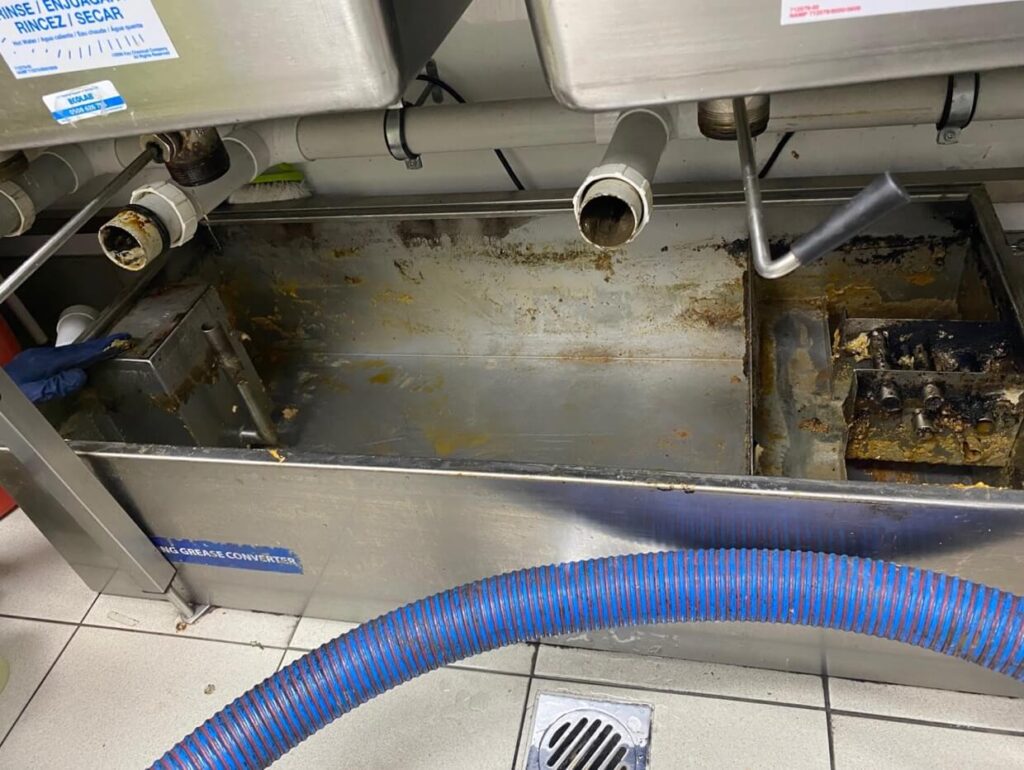
- Grease trap sizing in Kamloops isn’t a one-size-fits-all calculation — it depends on your kitchen’s fixture count, flow rate, and how your menu is structured. A trap that was right for a sandwich counter isn’t right for a full-service kitchen cranking out burgers and fries.
- An undersized grease trap fills faster, overflows into the municipal sewer, and puts you at risk of fines, failed health inspections, and costly emergency cleanouts.
- Interior Health and the City of Kamloops both have requirements around grease trap maintenance — if your trap is backing up or you’re pumping it every few weeks, that’s a signal it’s undersized, not just dirty.
- Most Kamloops restaurants should be getting their grease trap cleaned every one to three months, depending on volume. If you’re doing it more often than that, the sizing conversation needs to happen.
- At The Lux Loo, we’ve cleaned grease traps across Kamloops and the Thompson-Okanagan — we’ll tell you straight if what you’ve got isn’t matched to what your kitchen is actually producing.
If you’re running a restaurant in Kamloops, you’ve probably had the grease trap conversation at least once — usually right after something goes wrong. A slow drain. A backup. An inspection that didn’t go the way you hoped. And in most of those situations, the trap itself isn’t the problem. The size of the trap is. Grease trap sizing in Kamloops is one of those things that gets set once — usually during the build-out or when a previous tenant was in the space — and then never revisited, even as the kitchen’s volume or menu changes completely.
Here’s the thing: a grease trap that’s too small for your operation isn’t just inconvenient. It’s a compliance issue, a sewer infrastructure issue, and eventually, a health inspection issue. This post is going to walk you through how grease trap sizing actually works, how to tell if yours is wrong for your kitchen, and what happens if you leave it that way.
How Grease Trap Sizing Actually Works
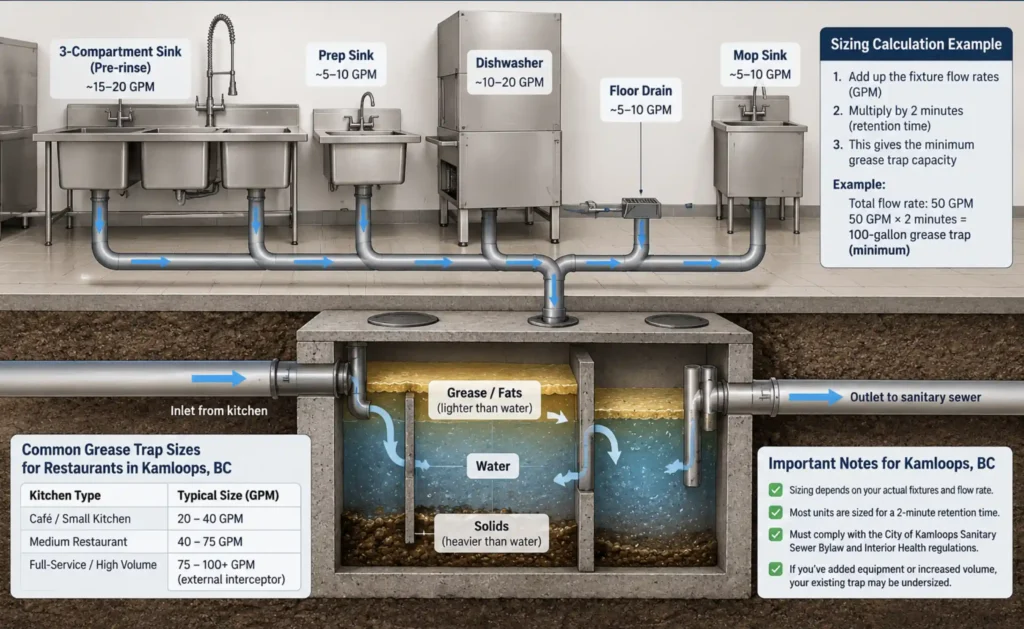
Grease traps are sized based on flow rate — specifically, the volume of wastewater flowing through the unit per minute, measured in gallons per minute (GPM). The calculation factors in the number of fixtures draining into the trap (sinks, floor drains, dishwashers, pre-rinse stations) and applies a retention time, typically two minutes under standard sizing guidelines.
So if you’ve got a three-compartment sink, a pre-rinse sprayer, and a mop sink all draining into the same trap, you add up their maximum flow rates, multiply by the retention time, and that gives you the minimum trap capacity you need. A typical small café might be looking at a 20–40 GPM unit. A full-service restaurant with a high-volume dishwasher and multiple prep sinks might need 50–100 GPM or more — and at that scale, you’re often talking about an external grease interceptor rather than an under-sink trap.
The problem we see constantly across Kamloops is restaurants that were built out for one concept and then converted to something heavier. A space that was a juice bar becomes a poutine counter. A coffee shop adds a full kitchen. The original trap sizing made sense for the original operator — it makes no sense for what’s happening in that kitchen now.
For a more detailed look at the difference between under-sink traps and external interceptors, our post on grease trap vs. grease interceptor for Kamloops restaurants breaks it down clearly.

Signs Your Grease Trap Is Undersized for Your Kitchen
You don’t need to be an engineer to figure out if your trap is working against you. There are some pretty reliable signals.
You’re pumping it more than once a month. The general rule of thumb is the 25% rule — your trap should be pumped when grease and solids reach 25% of its total capacity. If a properly sized trap for your kitchen volume is getting to that threshold every three or four weeks, it’s almost certainly undersized. We’ve seen Kamloops kitchens on weekly pump schedules that should realistically be on a quarterly one. That’s not a cleaning problem. That’s a capacity problem.
You’re seeing slow drains or backups during peak service. If your sinks are draining slowly during dinner rush, that’s often grease building up faster than the trap can process it. An undersized trap saturates quickly under high flow, and the grease starts finding its way downstream before it should.
You’ve changed your menu or volume significantly. This one’s easy to overlook. If you’ve added a fryer, expanded your hours, started doing a lunch service you didn’t have before, or your covers have doubled in the last two years — your grease trap requirements may have changed even if nothing else did.
You failed a health or municipal inspection related to grease. Interior Health and the City of Kamloops both take FOG (fats, oils, and grease) management seriously. If you’ve had a grease-related flag on an inspection, the sizing conversation is overdue.
What Actually Happens When Your Grease Trap Is Too Small
This is where it stops being theoretical. An undersized grease trap that’s chronically overwhelmed isn’t just expensive to maintain — it actively causes damage, and the consequences stack up fast.
First, grease gets into the municipal sewer system. That’s a problem for the City of Kamloops’s infrastructure, and when they trace it back to your address — and they do trace it back — you’re looking at fines. The City of Kamloops, like most BC municipalities, has bylaws that prohibit discharging grease into the sanitary sewer above threshold levels. Kamloops municipal bylaws give the city authority to issue orders and levy costs for sewer blockages traced to commercial operators.
Second, chronic grease backup inside your kitchen creates sanitation conditions that Interior Health won’t ignore. A drain that smells, backs up, or shows visible grease accumulation is a deficiency on an inspection report. Depending on severity, that can mean a compliance order, a re-inspection, or in the worst cases, a temporary closure.
Third — and this one catches people off guard — you’re paying more for cleanouts than you’d ever spend on a properly sized unit. We’ve talked to restaurant operators in Kamloops who were spending thousands annually on emergency pump-outs, enzyme treatments, and drain cleaning that they assumed was just part of running a kitchen. In more than a few of those situations, the right-sized trap would have cut that cost by more than half.
The BC Regulatory Context You Should Know About
In British Columbia, grease trap requirements for commercial food service operations are governed through a combination of municipal sewer use bylaws and Interior Health’s food premises regulations under the Food Safety Act. Interior Health’s food safety inspection program includes assessment of grease management as part of routine inspections — it’s not a separate process, it’s embedded in how your kitchen is evaluated.
What this means practically: there’s no single provincial standard that says “your trap must be X gallons.” Sizing is determined by your fixture load and flow rate, and compliance is assessed based on whether your system is actually functioning — i.e., whether grease is being intercepted before it reaches the sewer. If your trap is technically legal on paper but overflowing in practice, that’s a compliance failure regardless of what the permit says.
This is one area where getting a professional assessment matters more than reading a sizing chart. The calculation isn’t complicated, but it has to reflect your actual kitchen — not the kitchen that existed when the permit was pulled ten years ago.
What We Recommend for Most Kamloops Restaurant Operators
Here’s our honest take from having serviced grease traps across Kamloops and the Thompson-Okanagan: most sizing problems we encounter weren’t the result of bad decisions. They were the result of no decision — the trap was installed, nobody revisited it, and the kitchen evolved around it.
If you’ve never had a formal sizing assessment done, and your restaurant has been operating for more than a few years, it’s worth having someone come out and look at your fixture count and current volume against what you’ve got installed. Not to sell you something bigger necessarily — sometimes the unit is fine and the issue is frequency of service. But you need to know which problem you actually have.
For a full-service Kamloops restaurant doing consistent dinner service, our general experience is that quarterly cleanouts are the baseline, and monthly service is appropriate for higher-volume operations. If you’re pumping more often than that, something’s off. If you haven’t pumped in six months and you’re busy, something’s definitely off in the other direction.
You can browse everything we do in this space on our grease trap cleaning page — we cover sizing assessments, scheduled pump-outs, and emergency service across Kamloops and the region.
Conclusion
Grease trap sizing in Kamloops is one of those back-of-house details that’s easy to ignore right up until it becomes expensive or embarrassing — or both. The good news is it’s also one of the easier problems to solve once you actually know what you’re dealing with. An assessment takes less time than a busy lunch service, and getting the sizing right means fewer emergency calls, cleaner inspections, and a lot less money going down the drain (literally).
At The Lux Loo, we’ve been servicing grease traps across Kamloops and the Thompson-Okanagan since 2020, and we’re straightforward about what we find. If your trap is the right size and just needs regular service, we’ll tell you that. If it’s undersized for what your kitchen is producing, we’ll tell you that too — and help you figure out what the right next step looks like.
Give us a call or reach out online for a free quote. We offer same-week service across Kamloops and surrounding areas, and we’d rather you hear the honest answer from us than find out from a health inspector.