
Key Takeaways
- A grease trap and a grease interceptor do the same job — intercepting fats, oils, and grease (FOG) before they hit the sewer — but they’re not the same device, and the distinction matters for BC compliance.
- Grease traps are small, passive units installed under the sink. Grease interceptors are large, outdoor tanks — typically 750 to 1,500+ US gallons — installed underground.
- For most commercial kitchens in Kamloops, Interior Health and the City of Kamloops’s sewer use requirements point toward a properly sized interceptor, not a small under-sink trap.
- Sizing is where most restaurant owners get this wrong. An undersized unit — no matter what you call it — will fail the purpose and create compliance headaches fast.
- Cleaning frequency is non-negotiable. A grease interceptor that’s 25% full of solidified grease is not intercepting anything effectively. Regular pumping is the only thing that keeps the system working.
If you run a restaurant, café, food truck commissary, or any commercial kitchen in Kamloops or the wider Thompson-Okanagan, you’ve probably heard both terms: grease trap and grease interceptor. They’re used interchangeably by suppliers, contractors, and health inspectors — sometimes in the same conversation — which makes it genuinely confusing to know what you actually have, what you’re required to have, and whether you’re on the right side of BC regulations.
The distinction isn’t just semantic. It affects what you install, how often it gets pumped, what it costs, and whether you’ll pass inspection when Interior Health or the City comes knocking. At The Lux Loo, we’ve cleaned grease units at everything from small Kamloops delis to high-volume restaurant groups in the Thompson-Okanagan — and the most common problem we see isn’t a dirty trap. It’s the wrong unit, undersized, not being serviced often enough, and the owner having no idea which category they’re even in.
What’s the Actual Difference Between a Grease Trap and a Grease Interceptor?
Both devices do the same fundamental thing: they slow down greasy wastewater, allow fats, oils, and grease (FOG) to float to the surface and cool, and let cleaner water pass through to the drain or sewer. That’s where the similarity ends.
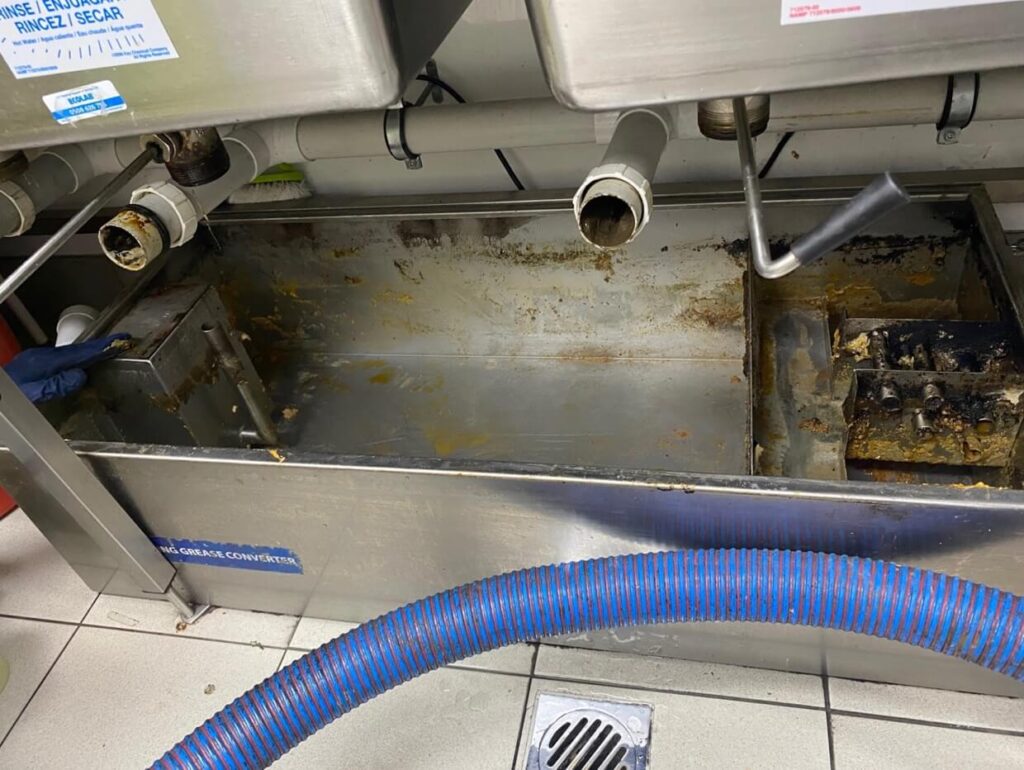
A grease trap — sometimes called a grease recovery device — is a small, passive unit, typically installed directly under a single sink or a prep area sink. They’re measured in gallons per minute (GPM) of flow rate, commonly in the 10–50 GPM range, and hold a relatively small volume of grease before they need cleaning. They’re inexpensive to install and can work well in low-volume food service situations: a small café, a concession stand, or a facility that does very light cooking.
A grease interceptor is a completely different scale. These are large precast concrete or polyethylene tanks — often buried underground outside the building — with capacities typically ranging from 750 to 1,500 US gallons or more. They serve the entire kitchen’s waste flow, not just one sink, and they’re designed to handle the volume that a real commercial kitchen produces. They’re measured in gallons (capacity) rather than GPM.
The short version: a grease trap is what you find under a sink. A grease interceptor is what you find buried in the parking lot. Most full-service restaurants in Kamloops need the latter.

What BC Regulations Actually Say — And What That Means in Kamloops
This is where a lot of restaurant owners get caught off guard. BC doesn’t operate on a single national standard here — grease management requirements come from a combination of the BC Sewerage System Regulation, municipal sewer use bylaws, and Interior Health’s food premises requirements. In Kamloops, the City’s Sanitary Sewer Bylaw No. 32-35 allows the City to require grease interceptors for commercial developments where excessive grease, oil, or other undesirable substances are being discharged into the sewer system, and requires those interceptors to be properly maintained and accessible for cleaning and inspection.
The practical reality we see on the ground: if you’re a full-service restaurant, a pub, a hotel kitchen, or any operation with multiple cooking lines and a dishwasher, you’re almost certainly required to have a properly sized grease interceptor — not a small under-sink trap. Interior Health food premise inspections will flag inadequate grease management, and a failed inspection isn’t just an inconvenience. It can hold up your operating permit.
Sizing requirements are typically based on your kitchen’s total fixture count and peak flow rate. The Plumbing Code of Canada (adopted in BC) provides the engineering framework, but local authorities can and do impose stricter requirements. If you’re not sure what you’re required to have, the first call should be to the City of Kamloops’s Engineering or Building department — and the second call should be to someone who actually services these units and knows what’s in the ground across town.
We’ve pulled up interceptors at Kamloops restaurants that were significantly undersized for the kitchen volume — installed years ago, never flagged until a health inspection triggered a closer look. Getting it right at the start is much cheaper than retrofitting.
The Sizing Problem — And Why It Matters More Than the Label
Here’s the thing we’ve seen play out more than once: a restaurant owner installs what their plumber calls a “grease trap,” it meets a checkbox somewhere, and then six months later they’ve got a slow drain, a smell problem, and an inspector asking questions. The issue usually isn’t the maintenance schedule — it’s that the unit was never sized correctly for the actual load.
A real-world example from our service runs: we were called to a mid-sized Kamloops restaurant that had been experiencing recurring drain issues. They had an under-sink grease trap servicing a kitchen that ran two fryers, a full grill station, and a commercial dishwasher. That trap was overwhelmed from the day it went in. It physically cannot handle the FOG load that kitchen produces. Cleaning it every two weeks wasn’t going to fix an engineering problem.
The rule of thumb most engineers use: a grease interceptor for a full-service restaurant should be sized to hold at least a 24-hour peak flow volume, with enough capacity that it can go 30–90 days between pump-outs without exceeding the 25% grease cap rule. That “25% rule” — often cited in municipal bylaws and industry standards — holds that a grease interceptor should be pumped before accumulated grease and solids exceed 25% of the tank’s total hydraulic capacity. Once you’re past that threshold, the unit isn’t intercepting effectively. Grease is passing through to the sewer, and you’re now contributing to the exact blockage problem these systems are designed to prevent.
If you’re unsure whether your current unit is properly sized, that’s worth finding out before an inspection tells you.
How Often Do These Units Actually Need to Be Cleaned?
This varies more than most people expect — and “every six months” is not a universal answer, even though it’s what a lot of operators assume.
For a small café with an under-sink grease trap and light cooking volume, monthly or bi-monthly cleaning is often appropriate. These small units fill up fast. For a properly sized underground grease interceptor at a mid-volume restaurant, cleaning every 60 to 90 days is a reasonable starting point — but the actual frequency should be driven by the 25% rule above, not a fixed calendar.
High-volume operations — busy pubs, hotel restaurants, banquet kitchens — can reach that threshold in 30 days or less during peak season. And summer in Kamloops is genuinely peak season. The Farmers’ Market crowd, the tourism traffic, the event catering load — all of it hits restaurant kitchens harder between May and September. We see it in our service schedule every year.
The honest answer is that the right cleaning frequency can only be established by monitoring your actual accumulation rate over the first few service cycles — not by guessing, and definitely not by waiting until there’s a problem. You can read more about what happens when grease traps go too long between cleanings in our post on the real consequences of skipping grease trap maintenance — it’s not a pretty picture, and the downstream costs dwarf what regular service runs.
Our grease trap cleaning service in Kamloops is built around helping restaurant owners figure out that baseline — then staying on schedule so it never becomes a crisis.

Which One Does Your Kamloops Restaurant Actually Need?
We get asked this directly enough that it’s worth giving a direct answer, even though the formal determination has to come from the City and your licensed plumber.
In our experience servicing commercial kitchens across Kamloops and the Thompson-Okanagan: if you’re running a full-service restaurant, a licensed commercial kitchen, a brewery with a food program, a hotel restaurant, or any operation with multiple cooking stations and a dishwasher, you almost certainly need a properly sized underground grease interceptor — not an under-sink trap. The volume of FOG that a real kitchen produces simply overwhelms a small passive trap within weeks.
Under-sink grease traps have their place — low-volume operations, secondary sinks in lower-use areas, food trucks with a dedicated commissary arrangement — but they are not a substitute for an interceptor in a high-output kitchen, and they won’t satisfy Kamloops’s sewer use requirements in that context.
If you’re opening a new food service operation and haven’t had this conversation with your plumber and the City yet, have it before you pour the floor. Retrofitting an underground interceptor into an existing building is expensive, disruptive, and entirely avoidable if you plan ahead.
And if you already have a unit installed and you’re not sure what category it falls into, what size it is, or when it was last properly cleaned — that’s a reasonable thing to find out now, not when an inspector is standing in your kitchen.
The Bottom Line
The grease trap vs. grease interceptor debate is one of those things that sounds like a technicality right up until it isn’t. Wrong unit, wrong size, wrong service schedule — any one of those creates real problems: slow drains, sewer backups, inspection failures, fines, and the kind of reputation hit that no restaurant in Kamloops needs.
At The Lux Loo, we’ve serviced grease units across the Thompson-Okanagan — everything from quick cleans on small café traps to full pump-outs on large interceptors at high-volume kitchens. We know what’s in the ground at restaurants across this region, and we’re straightforward about what we find. If something’s undersized, we’ll tell you. If it just needs a regular cleaning schedule, we’ll set that up and stick to it.
If you’re a Kamloops restaurant owner who’s not completely sure what you have, whether it’s sized right, or when it’s due for service — give us a call. We’re happy to take a look and give you a straight answer. Contact The Lux Loo today for a free grease trap service quote.