
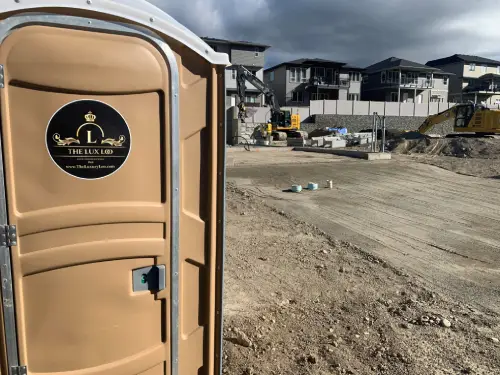
Key Takeaways
- BC’s Occupational Health and Safety Regulation requires employers to provide separate, dedicated washroom facilities for women on construction sites — a single shared porta potty doesn’t cut it anymore.
- The requirement isn’t new, but enforcement has sharpened as more women enter the trades. If you’re running a crew in Kamloops or anywhere across the Thompson-Okanagan, this is a compliance issue, not a suggestion.
- WorkSafeBC can issue stop-work orders and fines for non-compliance — the cost of a washroom trailer rental is nothing compared to the cost of a worksite shutdown.
- A dedicated washroom unit for women doesn’t have to mean a separate porta potty bolted to a far corner of the site. A properly spec’d washroom trailer solves the requirement and actually improves conditions for your whole crew.
- At The Lux Loo, we’ve helped Kamloops contractors get compliant quickly — often with same-week delivery across the Thompson-Okanagan.
If you’re a general contractor or site supervisor in Kamloops, chances are you’ve got the basics covered: you’ve got toilets on site, your crew knows where they are, and you haven’t had a WorkSafeBC inspector show up looking for problems. That’s a reasonable baseline. But there’s one requirement that a surprising number of construction sites across BC still aren’t meeting — and it’s getting harder to overlook as more women enter the trades.
BC law is clear. Women’s washroom facilities on construction sites aren’t optional, and a single shared porta potty doesn’t satisfy the requirement. If your site has female workers and you’re not providing separate, dedicated facilities, you’re out of compliance — full stop. This post breaks down exactly what the regulation says, what it looks like in practice, and what Kamloops contractors need to have on the ground to stay on the right side of WorkSafeBC.
What BC’s Occupational Health and Safety Regulation Actually Says
The requirement lives in Part 4 of BC’s Occupational Health and Safety Regulation, under the sections governing sanitation on worksites. The plain-language version: if you have workers of different genders on your site, you need to provide separate toilet facilities for each. One shared unit doesn’t satisfy this — not even if it locks.
The regulation also sets out minimum numbers. For sites with up to nine workers, you need at least one toilet. But the moment you have female workers on that site, the single shared unit stops being sufficient on its own. You need a separate facility designated for women. The regulation isn’t prescriptive about the exact form — it doesn’t say “washroom trailer” or “porta potty” — but it does say the facilities need to be in reasonable proximity to the work area, maintained in a sanitary condition, and actually usable.
That last part matters more than people think. A porta potty that’s been baking in a Kamloops summer for three weeks without a pump-out isn’t a compliant facility — it’s a liability. WorkSafeBC inspectors aren’t just checking whether a unit exists. They’re checking whether it’s functional and sanitary. On a busy construction site through July and August in the Interior, that means regular servicing, not just a drop-and-forget rental.
Why This Is Coming Up More Often Right Now
The regulation has been on the books for years. So why are more contractors suddenly getting flagged for it? A few reasons.
First, the trades workforce in BC is changing. The proportion of women entering construction, electrical, plumbing, and civil work has grown steadily — and WorkSafeBC has responded by paying closer attention to the conditions those workers face on site. Washroom access is near the top of that list.
Second, complaints-based enforcement has increased. When a female worker on a site doesn’t have a usable, private facility, she’s more likely now than she was ten years ago to know that’s not acceptable — and to say so. WorkSafeBC takes those reports seriously.
Third, larger general contractors are pushing the requirement down through their subcontractor agreements. If you’re a sub on a project in Kamloops and the GC’s safety plan requires separate facilities, that’s not just a company policy — it’s a condition of your contract. We’ve seen this come up on residential subdivisions, commercial builds, and infrastructure projects across the Thompson-Okanagan.
What “Dedicated Facilities” Actually Looks Like on a Real Job Site
Here’s a scenario we’ve dealt with directly. A mid-sized excavation contractor working a residential development site outside Kamloops called us in mid-project. They had six workers on site — including two women — and a single standard porta potty that had been on site since day one. A WorkSafeBC inspection flagged it. They needed a second unit, designated and signed for women, cleaned and serviced on a schedule that kept it actually usable through a hot Interior summer.
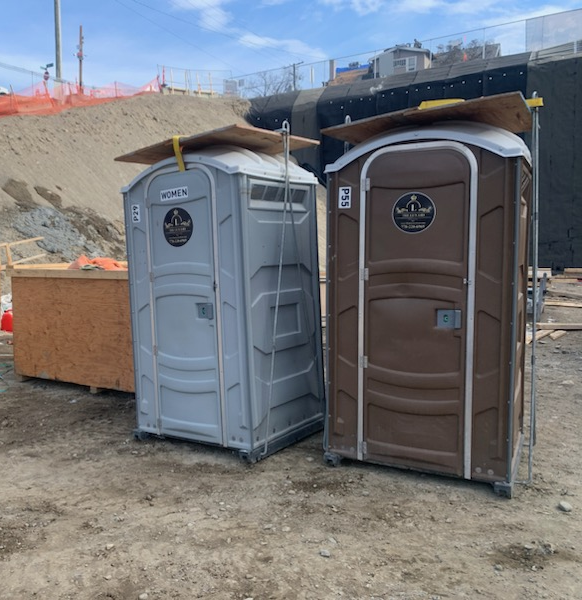
We had a unit delivered within the week. Signage went up. The inspection follow-up went fine. Total disruption to the project: minimal. Total cost compared to a stop-work order: not even close.
That’s the typical situation we see, and it’s almost always fixable quickly. The mistake contractors make is assuming the problem is complicated when it usually isn’t. You need a second unit. It needs to be clearly designated for women. It needs to be serviced regularly. And it needs to be positioned in a spot that’s accessible without a woman having to walk past the entire crew to use it. That last detail is a matter of basic dignity, and WorkSafeBC considers it.
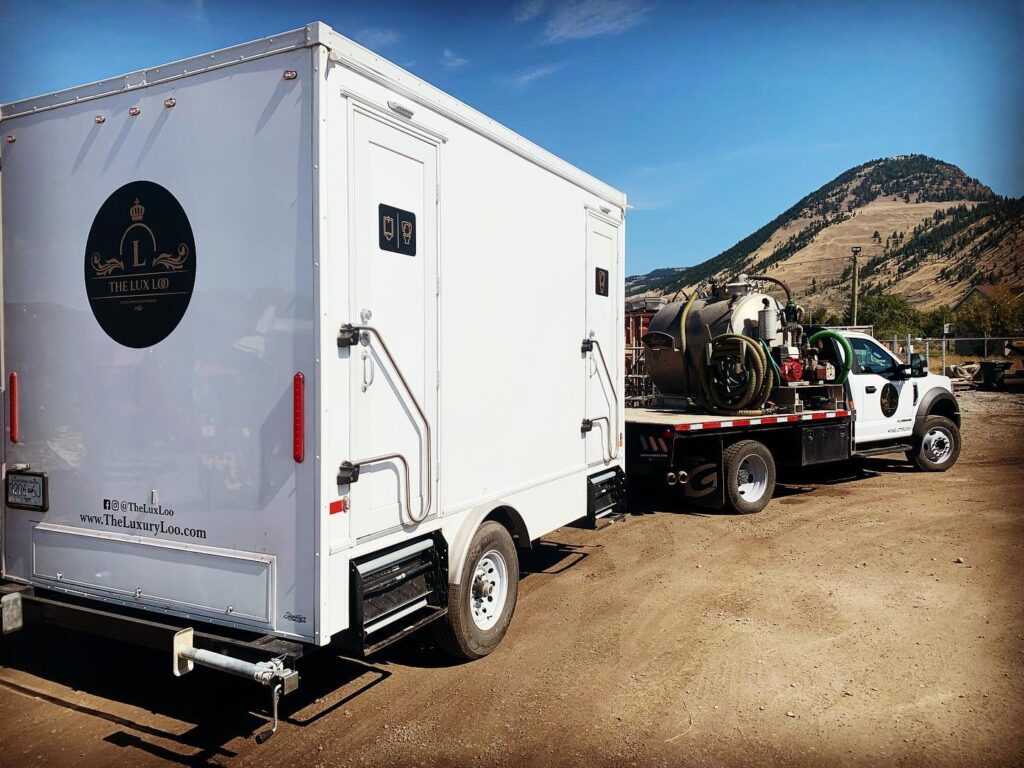
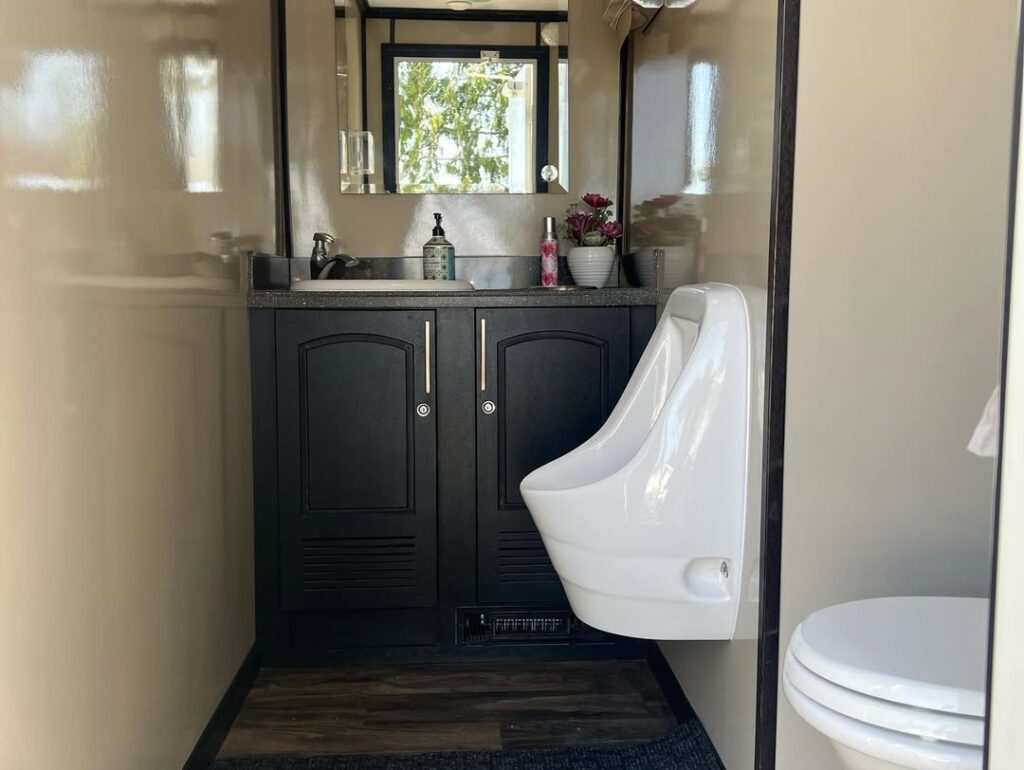
For larger sites or longer projects, a washroom trailer is often the cleaner solution. A trailer with separate compartments, running water, and a proper lock is a better experience for everyone — and it’s hard to argue it’s not compliant. We rent these across Kamloops, Merritt, Chase, Barriere, and the wider Thompson-Okanagan region, and on bigger commercial sites they’ve become the standard rather than the exception.
The Real Cost of Not Complying
Let’s be direct about this. WorkSafeBC has real teeth. Non-compliance with sanitation requirements can result in administrative penalties, and persistent or egregious violations can trigger stop-work orders. On a project where your crew is billing by the day and your schedule is already tight, a work stoppage over a washroom isn’t a minor inconvenience — it’s a significant financial hit.
There’s also the reputational angle, which matters more than it used to. Larger developers and municipalities in BC increasingly require contractors to demonstrate a commitment to site safety and inclusion as part of procurement. Showing up to a pre-construction meeting without a plan for gender-appropriate facilities is a bad look. Showing up with one is easy and costs very little relative to the contract value.
Our honest take, after servicing job sites across the Thompson-Okanagan for several years: the contractors who have this dialled in aren’t doing it because they’re afraid of inspectors. They’re doing it because they’ve figured out that a well-run site — including decent sanitation for the whole crew — actually runs better. Workers stay on site longer, morale is higher, and the project moves faster. The porta potty isn’t the most exciting part of running a construction company, but it’s one of the few things that can stop your whole site cold if you get it wrong.
For a look at how to size and spec the right units for your crew, our post on what it actually costs to rent a porta potty in Kamloops breaks down the numbers clearly — including what factors drive pricing up on longer projects.
What Kamloops Contractors Should Have in Place Right Now
If you’ve got women on your crew — or if you’re expecting to — here’s what compliance looks like in practice for most sites in our region:
- Separate unit, clearly signed. A standard porta potty designated for women, with a lock that works and signage that’s unambiguous. Not shared. Not “everyone uses the same one.”
- Regular servicing. In Kamloops summers, a high-traffic unit needs to be pumped at least weekly — sometimes more. Heat accelerates everything. A unit that hasn’t been serviced is not a compliant unit.
- Reasonable placement. The facility needs to be close enough to the work area to be genuinely usable, and positioned with some privacy. WorkSafeBC can and does consider placement as part of an inspection.
- A trailer for larger or longer projects. If you’re running more than 10 workers for more than a few weeks, a washroom trailer with running water, separate compartments, and proper lighting is worth the step up. It simplifies compliance and the crew will notice the difference.
If you’re not sure what your specific site needs, that’s a straightforward conversation. We’ve helped contractors across the Thompson-Okanagan figure out exactly what they need — not what’s overkill, and not what’s going to get them flagged. And for a broader look at how we approach jobsite sanitation, the jobsite toilet rental page covers the full range of what we offer.
The Bottom Line
BC’s requirement for dedicated women’s washroom facilities on construction sites isn’t a technicality — it’s a baseline standard that reflects the reality of a changing workforce. For Kamloops contractors, the good news is that getting compliant is usually fast, affordable, and a lot less complicated than the alternative. A stop-work order is complicated. A second washroom unit isn’t.
At The Lux Loo, we’ve been servicing job sites across Kamloops, Merritt, Chase, Barriere, and the Thompson-Okanagan since 2020. We know what WorkSafeBC looks for, we know what works on Interior job sites through every season, and we can usually get you set up within the week. If your site needs to get sorted — or if you want to get ahead of an inspection before it becomes a problem — call The Lux Loo for a free quote. We’ll tell you exactly what you need and what it’ll cost, with no runaround.