
Key Takeaways
- Most Kamloops-area households should pump their septic tank every three to five years — but household size, tank capacity, and usage habits shift that number significantly.
- HealthLink BC recommends servicing most systems every two to five years. In our experience, the households that stick to that schedule are the ones that avoid expensive emergencies.
- Waiting too long doesn’t just mean an unpleasant situation in your backyard — it can mean drain field damage that costs tens of thousands of dollars to fix.
- BC Interior conditions — clay-heavy soils, hard winters, and the freeze-thaw cycle — put extra stress on systems that are already pushed to their limits by infrequent pumping.
- There’s no universal answer, but there is a right answer for your property. The calculation isn’t complicated once you know the variables.
Most people don’t think about their septic tank until something goes wrong. That’s understandable — it’s underground, it’s doing its job quietly, and there are roughly a hundred other things competing for your attention. But septic tank pumping in Kamloops is one of those maintenance tasks where ignoring it long enough doesn’t just cost you money. It can cost you your entire drain field, your yard, and potentially your ability to sell your property without a hefty remediation bill attached.
We’ve pumped tanks across Kamloops, Merritt, Chase, Barriere, and the wider Thompson-Okanagan for years — everything from tidy newer systems on acreages outside of town to tanks that hadn’t been touched in fifteen years and were telling us about it loudly. The question we get most often isn’t “how do I fix this?” It’s “how did I let it get this far?” The answer is almost always the same: nobody told them what the actual schedule should be, so they guessed, and they guessed too long.
The Real Answer: How Often Should You Pump Your Septic Tank in Kamloops?
The standard advice you’ll find online — “every three to five years” — isn’t wrong, but it’s incomplete. HealthLink BC recommends servicing most residential septic systems every two to five years, and that range exists because the right interval depends on your specific situation, not a blanket rule.
Here’s how the variables actually play out:
- Tank size: A 1,000-gallon tank on a property with two people is a very different situation from that same tank serving a household of six.
- Household size: Every person added to a household increases the daily volume entering the system. A family of five can fill a tank two to three times faster than a couple living in the same house.
- What goes in: Heavy garbage disposal use, frequent laundry loads, and flushing anything that shouldn’t be flushed (wipes, “flushable” wipes — they’re not — paper towels) accelerate sludge and scum buildup dramatically.
- System age and condition: Older tanks, especially concrete ones with some cracking or root infiltration, may need more frequent attention.
Our general guidance for Kamloops-area households: if you have a standard 1,000–1,500 gallon tank and a household of three to four people, you’re looking at every three to four years. Smaller tank, larger family? Closer to every two years. Solo homeowner on a 1,500-gallon system? You might stretch to five — but we’d still recommend an inspection at the four-year mark rather than just hoping for the best.
Why Kamloops and the BC Interior Aren’t the Same as the Rest of the Province
This is the part that gets glossed over in generic septic content, and it matters. The Thompson-Okanagan has specific conditions that affect how hard your septic system has to work — and how quickly problems develop when pumping gets delayed.
The soils across much of the Kamloops area are clay-heavy or silty. That means drainage is slower than you’d see on the coast or in sandier regions. Slower drainage through the drain field means the system relies more heavily on proper tank function to pre-treat effluent before it hits the soil. When the tank gets too full of solids, that pre-treatment breaks down, and you’re sending partially treated sewage into a field that can’t handle it efficiently.
Then there’s the freeze-thaw cycle. BC Interior winters hit systems differently than coastal winters. Ground movement from repeated freezing and thawing can affect tank integrity over time, and a system that’s already stressed from being overfull is more vulnerable to those effects. We’ve seen cracked baffles and shifted lids on tanks that might have held together longer with regular maintenance taking some of the pressure off.
If you want a deeper look at how local conditions affect the overall lifespan of your system, our post on how long septic systems last in Kamloops and the Thompson-Okanagan covers that in detail. The short version: the Interior is harder on systems than most homeowners realize, and that makes regular pumping even more important here than in other parts of BC.
What Actually Happens When You Wait Too Long
This is the part nobody wants to hear, but it’s worth being direct about — because the cost difference between a routine pump-out and an emergency is significant.
Here’s the progression we see when a tank goes too long without service:
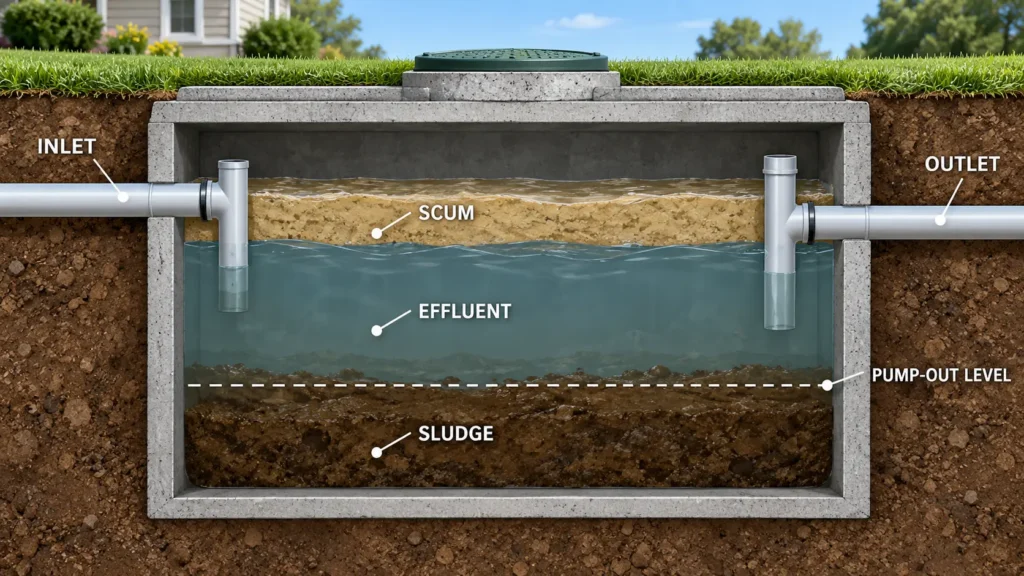
- Sludge and scum layers build up past safe levels. Every tank has a zone in the middle where liquid effluent flows out to the drain field. When sludge from the bottom and scum from the top crowd that zone, solids start moving out with the liquid.
- Solids reach the drain field. The drain field — the network of perforated pipes and gravel or soil below your yard — is not designed to handle solids. Once they start arriving, they clog the soil, and that clogging is largely irreversible.
- The drain field fails. This is the expensive part. Drain field replacement in BC can run anywhere from $10,000 to $30,000 or more depending on the size of the property and the scope of the repair. A pump-out costs a fraction of that.
- The signs show up in your yard — or your house. Soggy patches of grass that are suspiciously green. Odours near the tank or drain field area. Slow drains throughout the house. Sewage backing up into the lowest fixtures. By the time you’re seeing these, the damage is already underway.
We got a call last summer from a homeowner near Barriere who’d bought a property three years earlier. The previous owner had no pumping records, and the new owners assumed that if nothing was wrong, nothing needed doing. By the time we arrived, the tank was well past capacity. We pumped it, but the drain field had already taken damage. They were looking at a significant repair that a $400–$500 pump-out — done a year or two earlier — almost certainly would have prevented.
That’s not meant to scare you. It’s just what we see on the job. The math is pretty simple once you lay it out.
Signs Your Tank Needs Pumping Now — Not on a Schedule
Schedules are useful, but they’re not the whole picture. There are situations where your tank needs attention regardless of when it was last serviced, and knowing what to look for saves you from waiting until the problem forces your hand.
Call for a pump-out if you notice any of these:
- Drains in your home are slow across multiple fixtures — not just one sink, but throughout the house
- Gurgling sounds from toilets or drains, especially after using the washing machine or running a lot of water
- Sewage odours near the tank location, the drain field area, or inside the house near floor drains
- Wet or unusually green patches of grass over the drain field that aren’t explained by recent rain
- The tank lid or access risers are wet, shifted, or showing signs of pressure from below
Any one of these on its own might have another explanation. But if you’re seeing two or more, the tank should be your first call — not a plumber, not a drain cleaner. A pump-out and inspection will tell you whether the problem is in the tank or further along in the system.
For a broader look at how your septic system compares to municipal sewer options in the region, our post on septic vs. municipal sewer for Kamloops homeowners lays out the trade-offs clearly — including what the ongoing maintenance commitment actually looks like over time.
What a Professional Pump-Out Actually Involves
It’s worth knowing what you’re getting when you book a service call, because “pump it out” undersells what a proper job looks like.
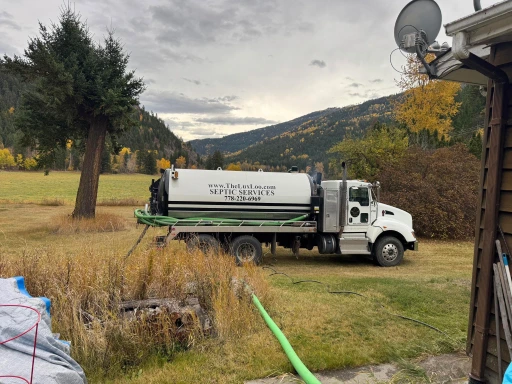
When The Lux Loo services a tank, we’re not just vacuuming out the liquid. A thorough pump-out means removing all three layers — the sludge at the bottom, the effluent in the middle, and the scum floating at the top. That requires breaking up the sludge layer, which can be dense and compacted in tanks that haven’t been serviced in a while, and ensuring the tank is as clean as it can reasonably be before we leave.

We also inspect the accessible components while we’re there: the inlet and outlet baffles, the condition of the tank walls, the lid and risers, and any visible signs of the drain field connections. If something looks off, we tell you — clearly, without upselling you on things you don’t need. If the baffles are deteriorating or there’s evidence of root intrusion, you should know that before it becomes a bigger problem.
Our septic tank pumping and cleaning service covers Kamloops and the surrounding Thompson-Okanagan area, including Merritt, Chase, Barriere, Sun Peaks, and beyond. If you’re not sure whether you’re in our service area, just ask — we’ve been surprised by how far out we’re willing to go when someone actually needs help.
Conclusion
There’s no mystery to septic tank pumping in Kamloops — but there is a right answer for your specific property, and “I’ll deal with it when something goes wrong” isn’t it. Most households in the Thompson-Okanagan should be on a two-to-four year cycle, with actual conditions guiding where in that range you fall. The BC Interior’s soils and climate make consistency more important here than in other parts of the province, and the cost of getting it wrong is dramatically higher than the cost of getting it right.
If you’re not sure when your tank was last serviced — or if you know it’s been longer than it should have been — that’s the right time to call. Not when the drains are slow. Not when the yard is soggy. Now.
Get in touch with The Lux Loo for a free quote on septic tank pumping in Kamloops and across the Thompson-Okanagan. We’ll give you a straight answer on what your system needs and what it’ll cost — no pressure, no guesswork.