
Key Takeaways
- Septic tank pumping and septic tank cleaning are not the same service — and using the wrong term with a provider can mean your tank doesn’t get the full treatment it actually needs.
- Pumping removes the liquid and floating scum layer. Cleaning goes further — it breaks up and removes the hardened sludge that accumulates on the bottom of your tank over years of use.
- Most Kamloops-area homeowners on rural properties need a full clean, not just a pump-out, especially if the tank hasn’t been serviced in more than three to five years.
- BC’s Interior climate, heavy summer use, and the age of rural septic systems in the Thompson-Okanagan mean that neglected tanks can fail faster than you’d expect — and the repairs are never cheap.
- At The Lux Loo, we service septic systems across Kamloops, Barriere, Logan Lake, Merritt, and the surrounding region — and we’ll tell you honestly what your tank actually needs.
If you’ve called around looking for septic tank cleaning in Kamloops and gotten quotes that seem wildly different from one another, there’s a good chance you and the service provider aren’t talking about the same thing. “Pumping” and “cleaning” get used interchangeably all the time — by homeowners, by contractors, and honestly, by some providers who should know better. But they’re not the same service, and the difference matters more than most people realize.
Here’s the short version: pumping removes what’s liquid and floating. Cleaning removes everything — including the compacted sludge layer at the bottom of your tank that doesn’t budge without proper agitation and high-pressure flushing. If your tank has been sitting for four or five years without service, a pump-out alone isn’t going to cut it. This post breaks down exactly what each service involves, when you need one versus the other, and what we see most often when we’re out servicing properties across the Thompson-Okanagan.
What Actually Happens During a Septic Tank Pump-Out
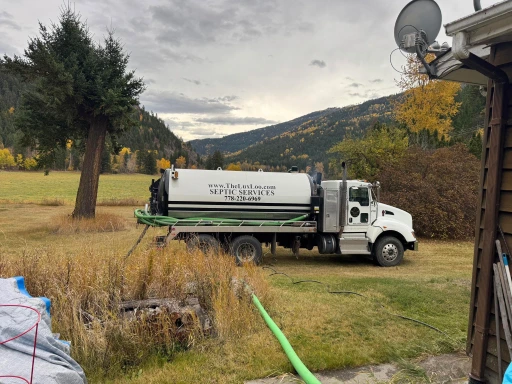
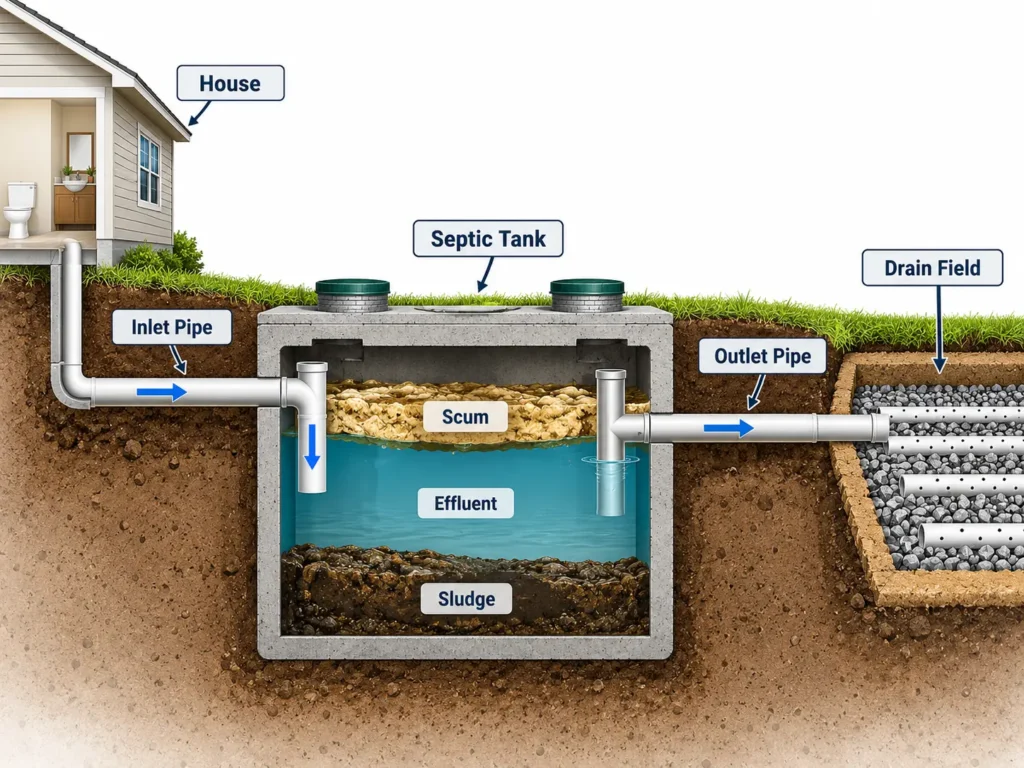
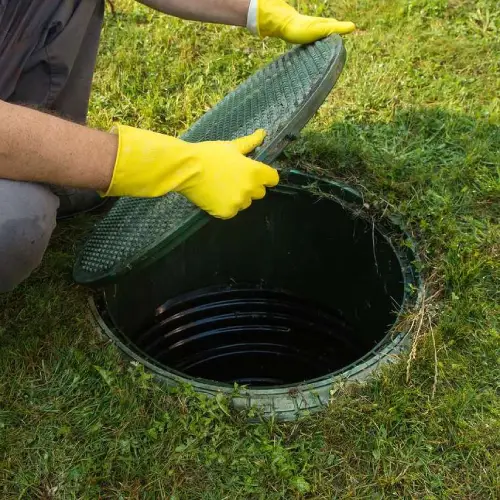
A standard septic tank pump-out is exactly what it sounds like. A vacuum truck pulls up, we access your tank’s lid, drop in a hose, and suck out the contents. What comes out is primarily the liquid effluent sitting in the middle of the tank, along with the scum layer — the lighter material (fats, oils, paper) that floats on top.
This is a necessary service. Done on the right schedule, it keeps your tank from overflowing into your drain field, which is one of those repair bills that makes people sit down when they hear the number. For a typical household of three to four people, pump-outs every three to five years are a reasonable baseline — though that varies depending on tank size, usage, and what’s going in. (We’ve written more about how to think through that schedule in our post on septic tank pumping in Kamloops and how often you actually need it done.)
The catch with a pump-out is what it doesn’t remove. The heavy, compacted sludge that settles to the bottom of your tank — years’ worth of solids — doesn’t just get sucked out with the liquid. It needs to be broken up first. If that layer gets thick enough, it starts reducing your tank’s effective capacity and can push solids through to your drain field. That’s where cleaning comes in.
What Septic Tank Cleaning Actually Involves — and Why It’s Different
A proper septic tank cleaning goes beyond the pump-out. Once the liquid layer is removed, the technician uses high-pressure water jetting to break up and dislodge the hardened sludge layer at the bottom of the tank. That material is then vacuumed out along with any remaining debris. The inside of the tank gets a proper rinse, and in some cases the technician will do a visual inspection of the inlet and outlet baffles while they’re in there.
Those baffles matter. They’re the components that direct flow into and out of your tank and help keep solids from moving through the system prematurely. They deteriorate over time, particularly older plastic or concrete baffles that haven’t been inspected in years. Finding a cracked or missing baffle during a cleaning is a straightforward fix. Finding out your drain field has been receiving raw solids for two years because a baffle failed undetected — that’s a very different conversation.
A full cleaning typically takes longer than a basic pump-out and costs more. But for a tank that hasn’t been properly serviced in several years, it’s the service that actually restores your system’s capacity. If you own a rural property in the Kamloops area — a hobby farm outside Pritchard, a cabin near Barriere, a house on acreage in Logan Lake — and your tank is more than a few years between services, you almost certainly need a cleaning, not just a pump.
A Scenario We See Regularly in the Thompson-Okanagan
We got a call last summer from a homeowner outside Kamloops who’d just bought a rural property. The previous owners had records showing the tank was “pumped” every few years — looked fine on paper. When we got out there and pulled the lid, the sludge layer had built up to the point where the tank’s effective capacity was reduced by nearly a third. The baffles were still intact, which was lucky, but the drain field was showing early signs of stress.
A pump-out alone would have removed the liquid and given the homeowner a false sense of security for another year or two. Instead, we did a full cleaning, cleared the sludge, inspected the baffles, and gave them an honest picture of where their system stood. It took an extra hour and cost more than a standard pump-out — but it was the right call, and they knew exactly what they had going forward.
This is genuinely common with rural property transfers in BC. Septic records are often incomplete, tank sizes are sometimes different from what’s documented, and a history of “pumping” on paper doesn’t tell you anything about whether the tank was ever properly cleaned. If you’ve recently purchased a property in the Thompson-Okanagan and you’re not sure what condition the septic system is in, a full cleaning and inspection is a reasonable place to start.
BC-Specific Factors That Affect How Often You Need Service
BC’s Interior has some specific conditions worth keeping in mind. The Thompson-Okanagan gets hot summers, and heat accelerates bacterial activity inside your tank — which isn’t necessarily a bad thing, but it does mean your system is working harder during peak season. If you have a vacation property near Shuswap Lake or Kamloops Lake that sits empty most of the year but gets hammered with guests in July and August, your usage patterns don’t resemble a typical full-time household. A standard “pump every three to five years” rule of thumb probably doesn’t apply to you.
BC’s Sewerage System Regulation under the Environmental Management Act requires that onsite sewage systems be maintained in proper working order — the responsibility sits with the property owner. There’s no province-wide mandated pump-out schedule, but Interior Health and regional districts can and do get involved when failing systems create public health or environmental concerns. A neglected septic system that’s leaching into groundwater isn’t just a problem for your property.
The honest advice from our end: don’t use the three-to-five year rule as a hard ceiling. Use it as a minimum. If you’re running a larger household, hosting guests regularly, or operating any kind of food preparation on your property, check your sludge levels more often. A good technician can measure the sludge depth and tell you where you actually stand.
So Which One Do You Actually Need?
Here’s a simple way to think about it. If your tank is on a regular service schedule — pumped every two to three years, system is working normally, no odours, no slow drains — a standard pump-out is likely sufficient for routine maintenance. Keep it up and you’re ahead of most people.
If any of the following apply, book a full cleaning:
- Your tank hasn’t been serviced in more than three to five years
- You’re not sure when it was last properly cleaned (not just pumped)
- You’ve recently purchased the property and don’t have reliable service history
- You’re noticing slow drains, sewage odours, or wet spots near your drain field
- Your household size or usage has increased significantly since the last service
And if you’re seeing signs of active drain field stress — standing water near the field, persistent odours outside, sewage backing up into the house — that warrants a conversation beyond just cleaning. The septic system may need assessment by a registered onsite wastewater practitioner, and in some cases Interior Health will need to be notified.
Our septic services page covers what we offer across Kamloops and the Thompson-Okanagan, and we’re always happy to talk through what your specific situation looks like before you book anything.
Conclusion
Pumping and cleaning are related services, but they’re not interchangeable — and knowing the difference can save you from a false sense of security and a very expensive drain field repair down the road. If you’re a Kamloops-area homeowner on a rural property and you’re not entirely sure what your tank has actually received over the years, the answer is almost always a full cleaning and inspection. It costs more upfront and it’s absolutely worth it.
At The Lux Loo, we’ve been servicing septic systems across Kamloops, Barriere, Merritt, Logan Lake, and the broader Thompson-Okanagan since 2020. We’ll give you a straight answer about what your system actually needs — no upselling, no guessing. Give us a call or request a free quote online, and we’ll get out to your property and take a proper look.