
What Really Happens When You Skip Grease Trap Cleaning in Kamloops
Key Takeaways
- A neglected grease trap can go from “smelly inconvenience” to full kitchen shutdown faster than most restaurant owners expect.
- Interior Health Authority inspections in BC can result in fines or temporary closures if your grease management is out of compliance.
- FOG (fats, oils, and grease) buildup doesn’t just affect your trap — it backs up into your drain lines, your floors, and eventually your neighbours’ pipes.
- Most Kamloops commercial kitchens should be servicing their grease trap every 1 to 3 months, depending on volume.
- The Lux Loo offers thorough grease trap pumping and cleaning across Kamloops and the Thompson-Okanagan — and we’ve seen what happens when it gets delayed.
Introduction
Nobody opens a restaurant thinking about their grease trap. You’re thinking about the menu, the staff, the soft launch. The grease trap is just… under the sink, doing its thing. Until it isn’t. Grease trap cleaning in Kamloops is one of those maintenance tasks that feels optional — right up until the moment it becomes an emergency. We’ve pulled up to commercial kitchens where the staff had been complaining about a slow drain for weeks. By the time we got there, the trap was so full it had started pushing FOG back into the kitchen lines.
This post is about what actually happens — step by step — when grease trap maintenance gets skipped. Not the sanitized version. The version we see on the ground across Kamloops, Merritt, and the Thompson-Okanagan every week.
Stage One: The Smell Nobody Can Explain
It usually starts with a smell. Not an obvious, catastrophic smell. Just something a little off near the prep area. Staff assume it’s the drains. Someone pours bleach down the sink. It doesn’t help.
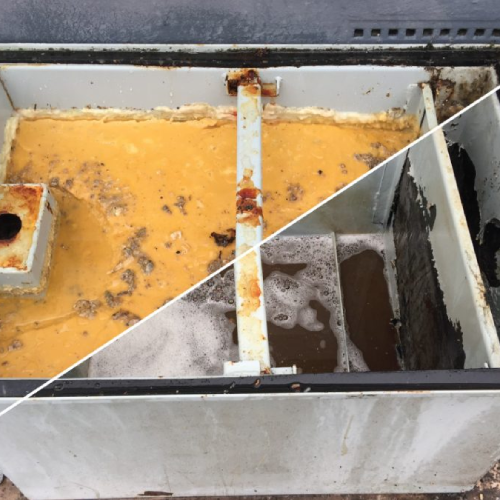
What’s actually happening is that your grease trap — which is designed to intercept fats, oils, and grease before they reach the municipal sewer — is getting full. As the FOG layer thickens and the solids at the bottom accumulate, anaerobic bacteria start breaking it all down. The byproduct of that process is hydrogen sulfide gas. That’s the rotten egg smell you can’t get rid of with bleach or air freshener.
At this stage, the fix is simple: a standard pump-out and cleaning. We’re talking a straightforward service call, an hour on-site, and you’re back to normal. Most high-volume kitchens in Kamloops — think busy pub kitchens, fast-casual spots, anything frying daily — should be at this stage every 4 to 6 weeks. Lower-volume kitchens might get to 3 months before they hit this point. The rule of thumb we use: if your trap is 25% full of grease and solids, it’s time. Don’t wait for 50%.
Stage Two: Drain Slowdowns and Backups
If the smell gets ignored — or masked — the next thing that happens is your drains start slowing down. This is where restaurant owners often call a plumber instead of a grease trap service, which is an expensive mistake. A plumber can clear the immediate blockage, but if the trap itself is overloaded, you’ll be back to the same problem within days.
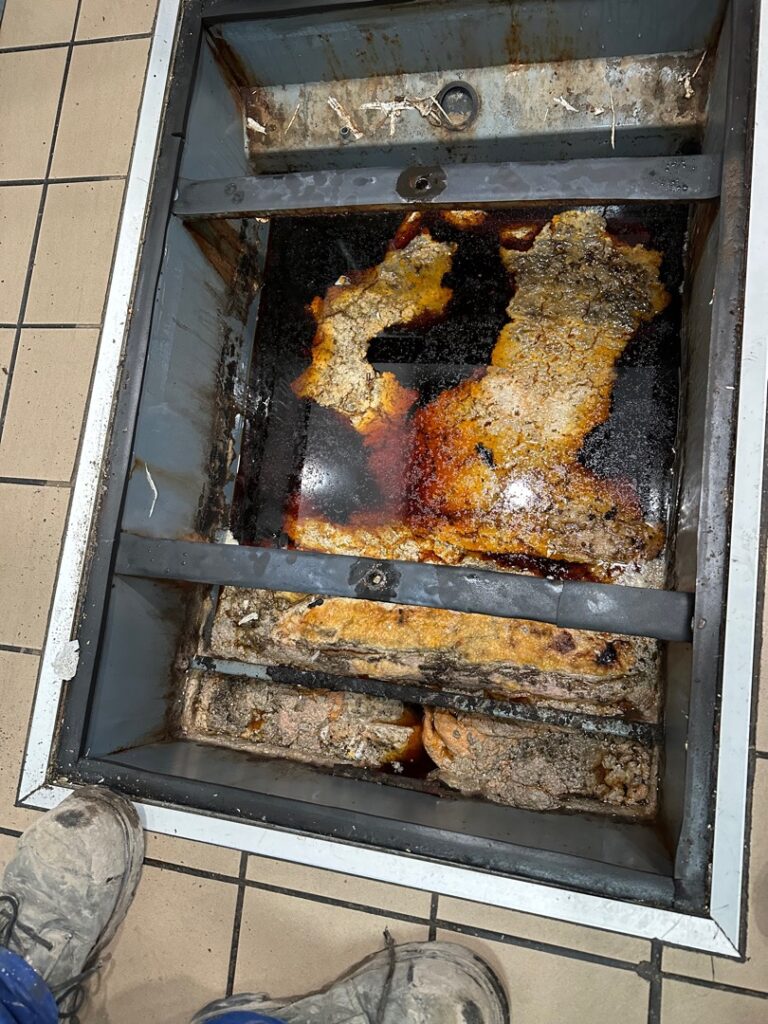
Here’s what’s happening mechanically: once a grease trap reaches capacity, it stops intercepting FOG effectively. Grease starts passing through into your lateral drain lines. As it cools, it solidifies. Over time, this builds up into a hardened clog that narrows — and eventually blocks — your pipes entirely.
We serviced a sit-down restaurant in Kamloops last summer that had been dealing with slow floor drains for almost two months. The owner had been snaking the lines every few weeks. When we finally got into the grease trap, it was at roughly 80% capacity and had been pushing congealed grease into a 15-metre stretch of lateral pipe. The trap pump-out fixed the problem, but the owner still had to bring in a hydro-jet service to clear the lines — a cost that could have been avoided entirely with regular grease trap maintenance.
Slow drains are a symptom. The grease trap is almost always the cause.
Stage Three: Health Authority Involvement
This is the one that really gets people’s attention.
In BC, commercial food premises are regulated under the BC Food Premises Regulation, and Interior Health Authority conducts inspections across the Kamloops region. Grease management is part of that picture. If an inspector finds evidence of FOG overflow, sewage odours in the kitchen, or a grease trap that hasn’t been serviced in an unreasonable period, that’s a compliance issue. In serious cases, it can result in a corrective order — or a temporary closure until the problem is resolved.
We’re not trying to scare you. But it’s real. A local café near Kamloops that was flagged during a routine inspection for sewage odour was traced back to an overloaded grease trap that hadn’t been pumped in nearly eight months. The corrective order required immediate service and documentation of an ongoing maintenance schedule. Interior Health doesn’t expect perfection — they expect a plan.
The good news: having a regular grease trap cleaning schedule with a licensed service provider gives you exactly that. Keep your service records. They’re your paper trail if anyone asks.
For more information on what BC’s Interior Health expects from commercial kitchens, visit the Interior Health food safety page.
Stage Four: Infrastructure Damage and Emergency Costs
Let’s talk money. Because this is where “I’ll deal with it later” gets genuinely expensive.
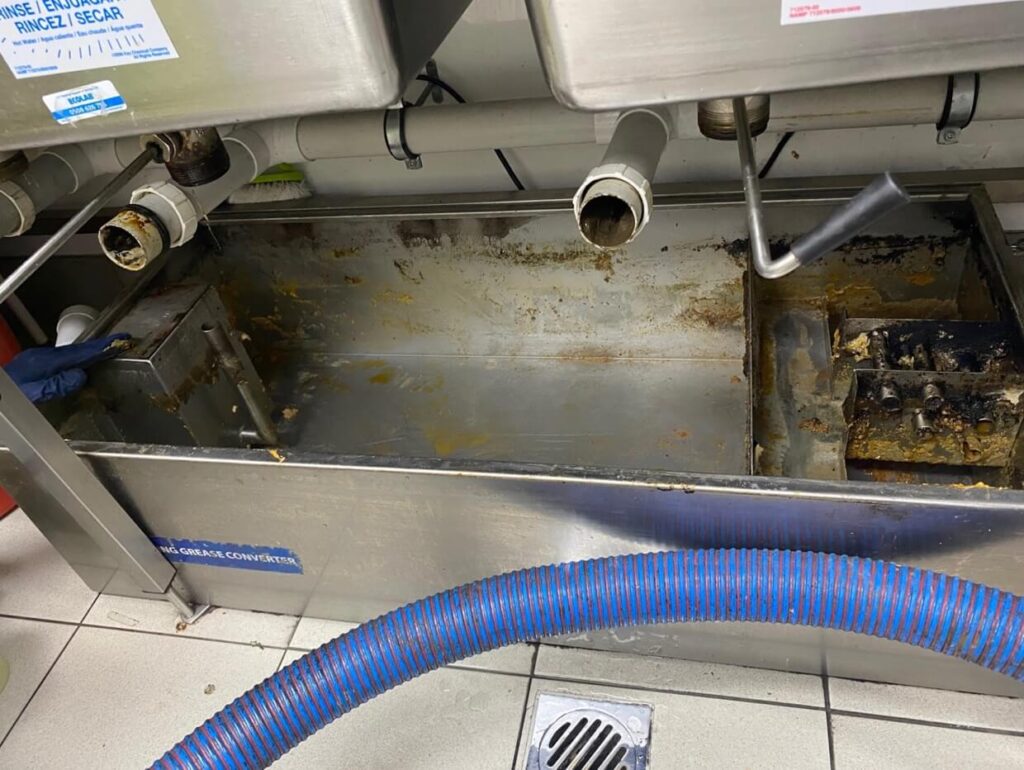
When FOG overflows your grease trap and enters the municipal sewer system, the City of Kamloops — like most BC municipalities — can hold you liable for costs associated with clearing sewer blockages that originate from your property. If your FOG contributes to a sanitary sewer overflow, the bill you receive isn’t a service call. It’s a municipal remediation invoice.
Beyond municipal liability, the internal costs compound fast: emergency plumbing at after-hours rates, potential kitchen closure during repairs, lost revenue, and in some cases, damage to flooring or subfloor if a backup has been seeping unnoticed. We’ve seen kitchens where a floor drain backup had been slow-leaking under tile for weeks before anyone realized the subfloor was saturated.
A routine grease trap pump-out costs a fraction of what any one of these scenarios costs. We’re not exaggerating when we say that consistent grease trap cleaning is one of the highest-ROI maintenance decisions a Kamloops restaurant can make. Not because it’s exciting. Because the alternative is genuinely painful.
How Often Should Kamloops Restaurants Actually Clean Their Grease Trap?
Here’s the honest answer: it depends on your volume, but most kitchens are waiting too long.
The standard guidance is to pump when the trap reaches 25% capacity — a measurement that combines the FOG layer on top and the solids layer at the bottom relative to the total trap volume. In practice, that means:
- High-volume kitchens (busy restaurants, pubs, commercial catering): every 4 to 6 weeks
- Mid-volume kitchens (café, smaller restaurant, food trucks with a fixed location): every 6 to 10 weeks
- Lower-volume operations (small café, occasional catering kitchen): every 2 to 3 months
If you genuinely don’t know how full your trap is or how long it’s been since the last service, that’s a signal to book an inspection now — not next quarter. We’ve found traps across the Thompson-Okanagan that hadn’t been touched in over a year. At that point, it’s not a pump-out. It’s an excavation.
One more thing: if you’ve recently changed your menu to include more deep frying, added a high-output fryer, or picked up a large catering contract, your existing service schedule may no longer be adequate. Volume changes mean the math changes.
Conclusion
Grease traps are easy to ignore because they’re out of sight and they work quietly — until they don’t. By the time most restaurant owners in Kamloops realize there’s a problem, the situation has already moved past “quick fix” territory. The smell, the slow drains, the compliance flag, the emergency plumbing bill — these aren’t worst-case scenarios. They’re what we see regularly across the region.
The fix is simple: stay on a schedule. Know your trap’s capacity, track your service dates, and don’t wait for a symptom to force your hand.
At The Lux Loo, we provide thorough grease trap pumping and cleaning for restaurants, commercial kitchens, food trucks, and hospitality operations across Kamloops and the Thompson-Okanagan. We’re local, we’re licensed, and we’ve seen enough backed-up traps to know exactly what you’re trying to avoid.
Call The Lux Loo today for a free quote on grease trap cleaning in Kamloops. It’s one call that pays for itself.